Charities don’t compete. They form moral monopolies
Every charity is, in its own small way, a monopolist. Which explains more than you'd think.


As a business, if all else fails, you can just try and copy someone else, but do it better or cheaper.
You can be the Aldi to the Asda, the Monzo to the Barclays, or Google to the Yahoo. But when it comes to charities, that doesn’t work.
The concept is faintly ridiculous:

Instead, charities carve out moral monopolies. They end up “owning” a particular combination of problem, solution and location. It could be geographic: being the “community centre for the Kingsmead Estate”. You could be the only organisation that cares about a particular problem, like the “Shrimp Welfare Project”. Or, you could have a novel way to address a more common issue, like using volunteer organised runs in parks to encourage greater physical activity.
Charity done well is good, charity done better, is better. But, through some combination of no shared understanding of what “better” is, an inability to measure it, or a simple lack of strong donor demand for tangible measures, charities rarely compete on this. The implications are interesting.
Moral matchmaking
For a charity, fundraising becomes more about finding a match between your “moral monopoly” and a donor/funder’s interests. You can be most successful by doing 2 things:
- Picking an attractive and distinctive moral monopoly
- Reaching all the potential donors whose interests match your choice
Unfortunately, number 1 might not really be an option. If you have a legal mandate set over 100 years ago, you probably can’t change it. If you’re a local charity based in an area no one wants to fund, you’re not MK Dons — you can’t really move. This is when you have to get creative — stretching your description of a project to make it sound more distinctive:

Growing up is a trap
As a charity, if you can’t in some way articulate your uniqueness, if you find yourself saying “we’re pretty much just a youth club”, you are probably a little doomed.
And often, the biggest risk to losing this distinctiveness is in trying to scale a small charity. Working on a niche problem, or in particular local area comes with a sense of identity which is neat and easy to draw: a local community centre can probably colour on a map the area in which they have a “moral monopoly”.
A business that starts small or local might start to expand by doing the same thing elsewhere: opening new locations, offices, shops etc. They lose the cosy “independent and local” brand, but gain economies of scale. The costs of the same staff, distribution network, suppliers can be spread across a wider area, and they can use this saving to improve their product or cut prices and get new customers. In contrast, charities can make these effectiveness improvements, but because they can’t really compete on price, they get no credit for it. They lose the local distinctiveness for little return.
The charities that have scaled successfully have been because the size or importance of the problem increased (e.g. climate charities, food banks), or because their method/model for addressing the problem was genuinely differentiated (e.g. Parkrun, Samaritans). But without an extremely clear-eyed assessment of whether this is true for a small organisation, scaling for scaling’s sake is pretty dangerous.
How do you compete with that?
But say you’ve avoided this danger. You’ve carefully distinguished your mission and your approach from all the other community groups around you.
Now you’re all in the same grant pot. You’re going for the same Government contract. You want to hire the same staff.
How do you win, when there are no clear, comparable metrics available to keep score?
You’re again reliant on hoping your particular moral claim happens to align better than the rest. It’s a beauty contest where you don’t meet the judges, don’t know the criteria, and only find out afterwards that this year they were really interested in intergenerational loneliness.
It’s no secret charities hate these processes, but funders and commissioners find them extremely difficult too.
It’s all too easy for any critique of an organisation to feel like disagreement with its mission, as if pointing out problems with Cancer Research means you’re pro-Cancer.
But for charities, the currency the moral monopoly produces isn't profit — it's uncriticisability.
Is it NICE to see what works?
So people have proposed solutions. If the problem is that charities are hard to compare in a fair and tractable way, the answer is obvious: make them comparable.
Strip out the local story, the emotional connection, and the moral claims, and get out the spreadsheets and randomised controlled trials. How much good does this project do? For whom? At what cost? Compared to what?
That’s the promise of Effective Altruism, GiveWell, NICE and the What Works Centres. There’s a push, backed by big money, to try and funnel funding based on measures like “Quality-Adjusted Life Years saved”, framed as researching “cost-effective ways to give”.
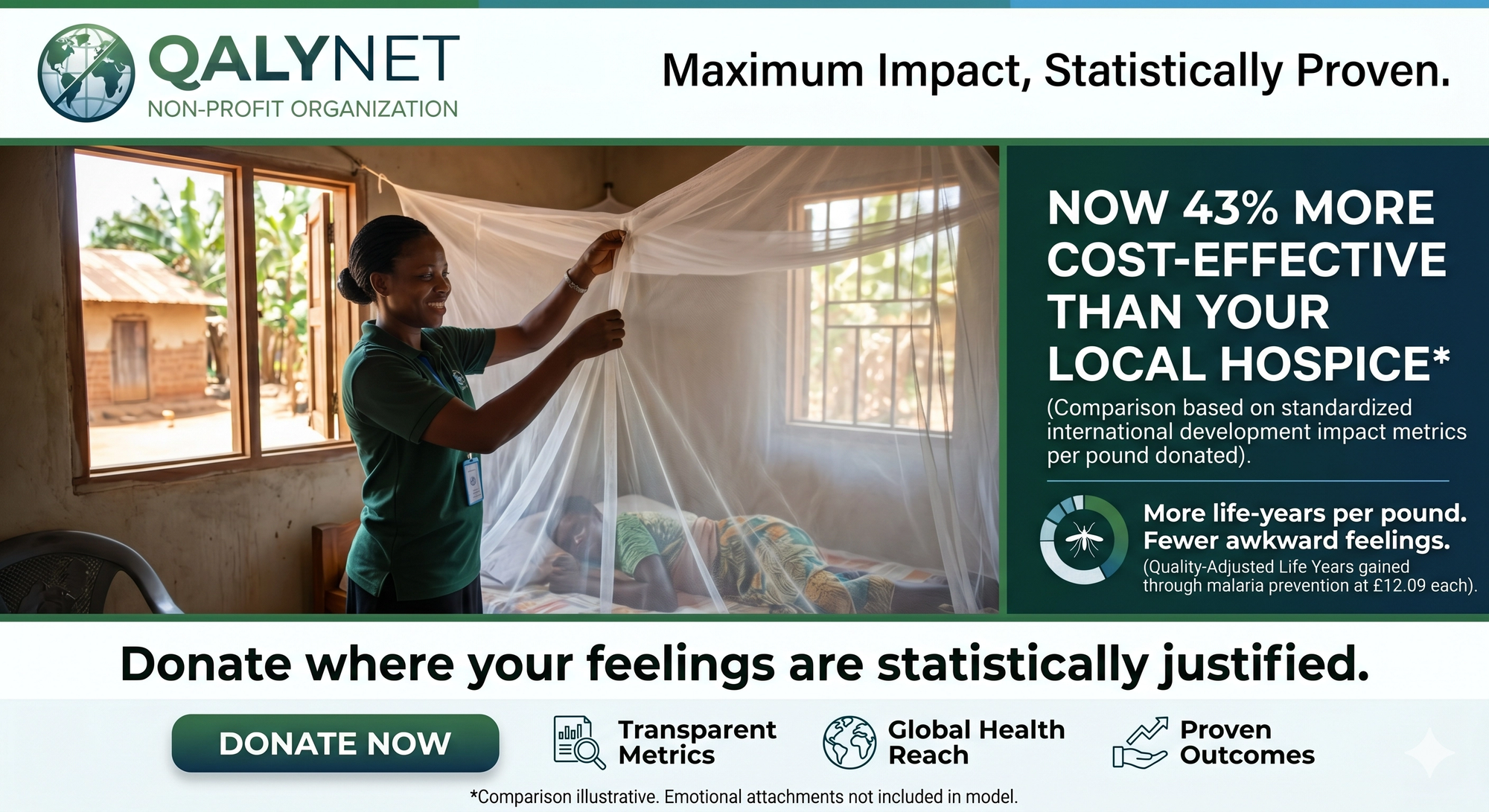
But a charity’s moral claim depends on its distinctiveness: the sense that you’re always comparing apples to oranges, or air ambulances to malaria nets.
Standardised measures flatten that. It coldly extracts the uniqueness, and substitutes an effect size and a confidence interval. Most threateningly, it means you can be ranked. You can win or lose.
There’s been a huge backlash to these measurement attempts. Some of that backlash is right. Standardised measures often can’t capture what really matters. They can reduce dignity and community to a spreadsheet, and mistake what’s counted for what counts.
But perhaps sometimes it is simpler than that: no monopolist likes competition.