Who are grant applications for?
Applications matter for Equitable Grant Making
When thinking about how to make grants more accessible, the applications is often overlooked. We want to change this at Plinth and we think more foundations should do the same.
For many small charities and community groups, applying for a grant involves navigating a portal that doesn't work properly on a phone, deciphering jargon-heavy guidance notes, and somehow finding several uninterrupted hours to write considered answers to twelve open-ended questions, usually while running service delivery. They're structural barriers and they don't filter out weak applications. They filter out under-resourced ones.
The National Council of Nonprofits reports that 92% of American nonprofits operate on less than $1 million a year. Yet research from the Urban Institute shows that the largest organisations receive nearly half their revenue from institutional sources, while the smallest get less than a fifth. The organisations doing the most community-level work are consistently the ones least able to navigate the systems designed to fund them.
Therefore the application experience (whether intention or not) becomes a gatekeeping mechanism.
The hidden assumption in grant portals
Most grant management systems are designed with the funder's workflow in mind. That makes sense the funder is paying for the software.The applicant experience tends to be an afterthought: functional enough to get forms submitted and into the system, rarely designed to make submission easy, let alone monitoring and evaluation. And because the foundation doesn't have to complete the questions, they aren't often incentivised to make the application as short and easy as possible.
The assumption baked into most portals is that the applicant has time, a laptop, and probably a grants writer. In reality, many of the organisations applying are run by volunteers squeezing in admin between shifts, or by small teams wearing too many hats. The average community group doesn't have a dedicated fundraiser. They're doing their best with limited time and limited confidence that the effort will pay off.
We all know the process frustrates applicants but it is also indirectly keeping organisations from applying.
What accessible grant making looks like
At Plinth, we’ve spoken to literally hundreds of grassroots charities (check out free Plinth here) and designed the applicant experience as carefully as the funder-facing one. Some features were easy, low hanging fruit, to add and some we haven’t seen anyone else attempt.
The Easy Stuff:
We think these features are the bare minimum and we were honestly surprised to learn not even form included:
- Forms should be clean and navigable, with guidance sitting alongside each question rather than buried in a separate PDF.
- Questions should reveal progressively, so applicants aren't confronted with a wall of fields on page one
- However applicants should be able to see all the questions up front so they divide and conquer across the team
- People should be able to save their progress and return later, from whatever device they're using.
- Organisations should be able to invite other members of their team to fill out the application
- Organisations should be able to see their previous applications with that funder in one place
The AI Stuff:
We’ve taken things a step further and made the application a helpful tool of the applying organisation not a hurdle.
It’s common to see an eligibility quiz before an application but, we found organisations would just answer the questions so they could get to the application form and apply even if they weren’t eligible. To be more upfront, we’ve built a website checker, that gives applicants their likelihood of success, so they know they risk they’re taking if they do apply
It can be turned on any application and made mandatory or just suggested:
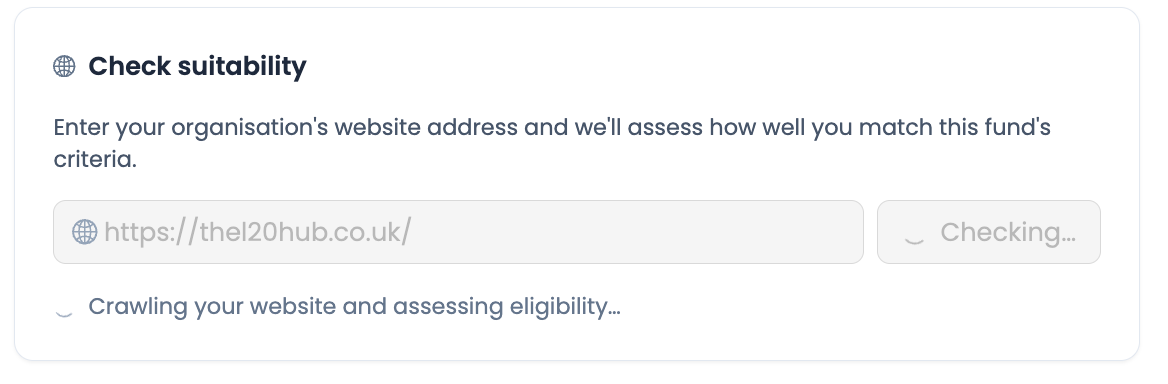
You can see how L20 Youth Hub did:
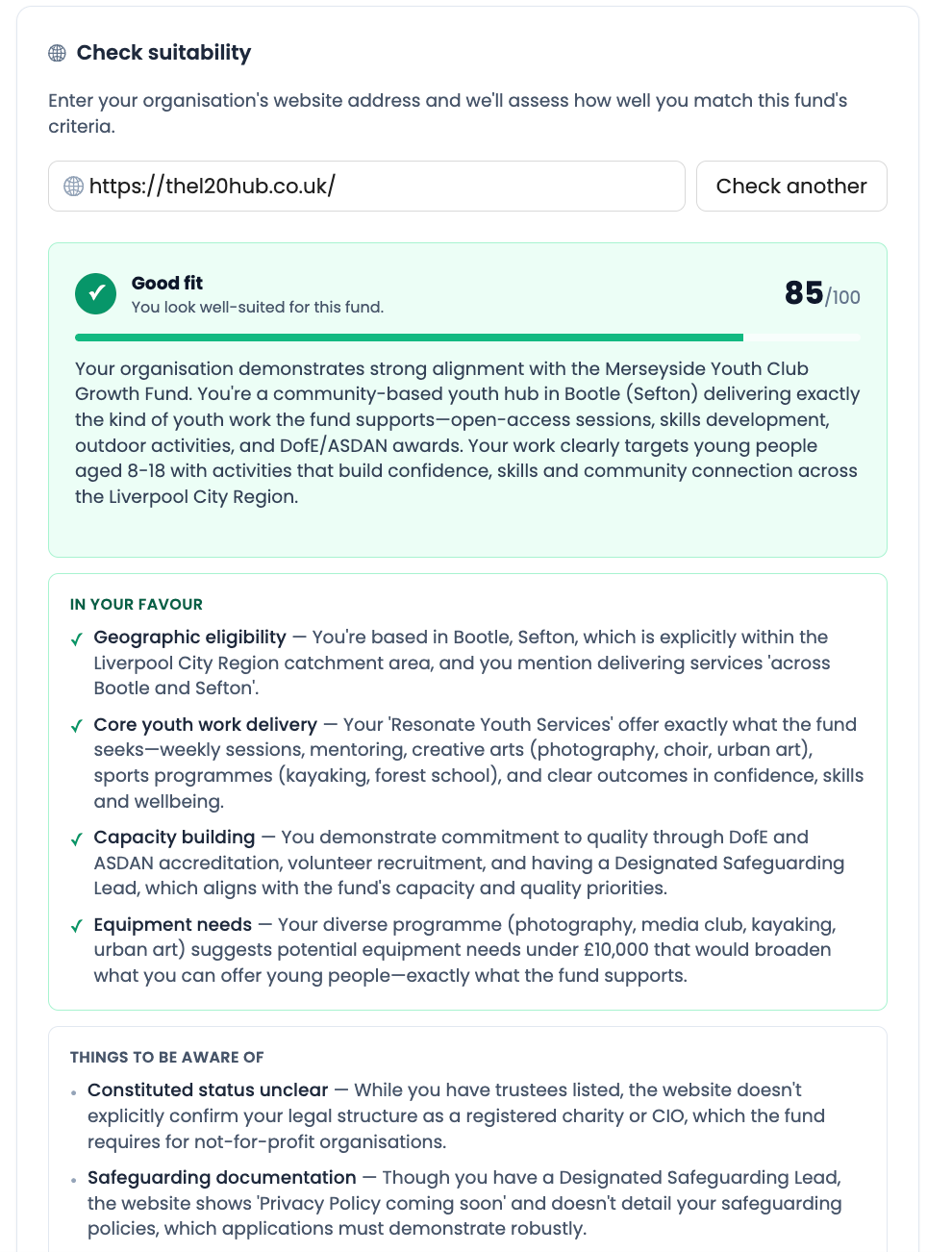
Nice, looks like they should apply!
Another way we've made the application more ethical, that seems to have some uptake in the US. Applicants can upload a previous grant application, and Plinth's AI will use it to intelligently pre-populate a new form, adapting existing answers to suit different questions. We already knew that organisations spent a lot of time reworking pasted answers and we figured we might as well use the work they were already doing to help write the new answers. Plinth doesn’t write applications for organisations, but to help them articulate what they're already doing in a way that does justice to the work.
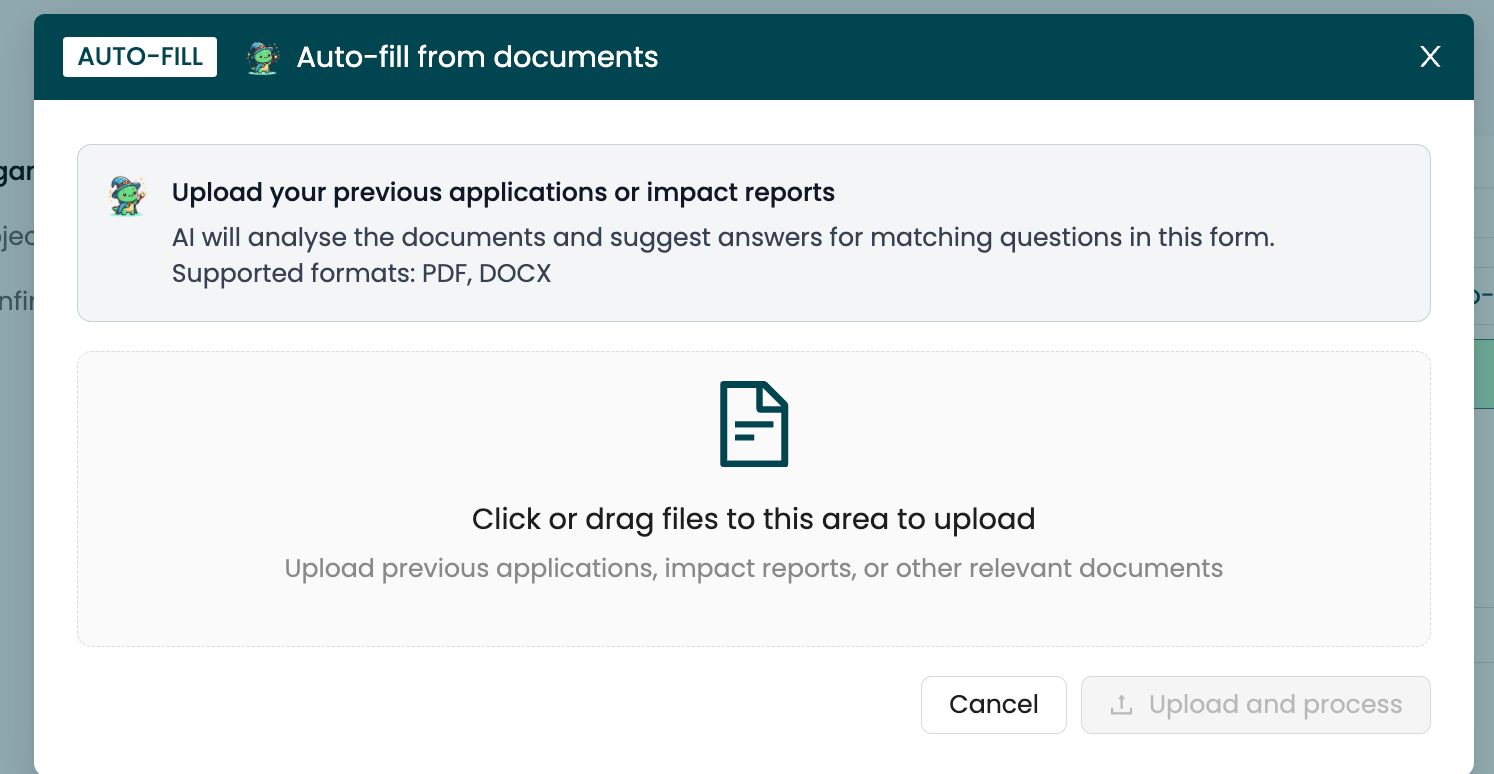
For organisations applying to multiple funders at once, which most small charities are, this is a significant shift. The administrative burden of running parallel applications is one of the least discussed drains on the sector. Anything that reduces it frees up time for the actual work.
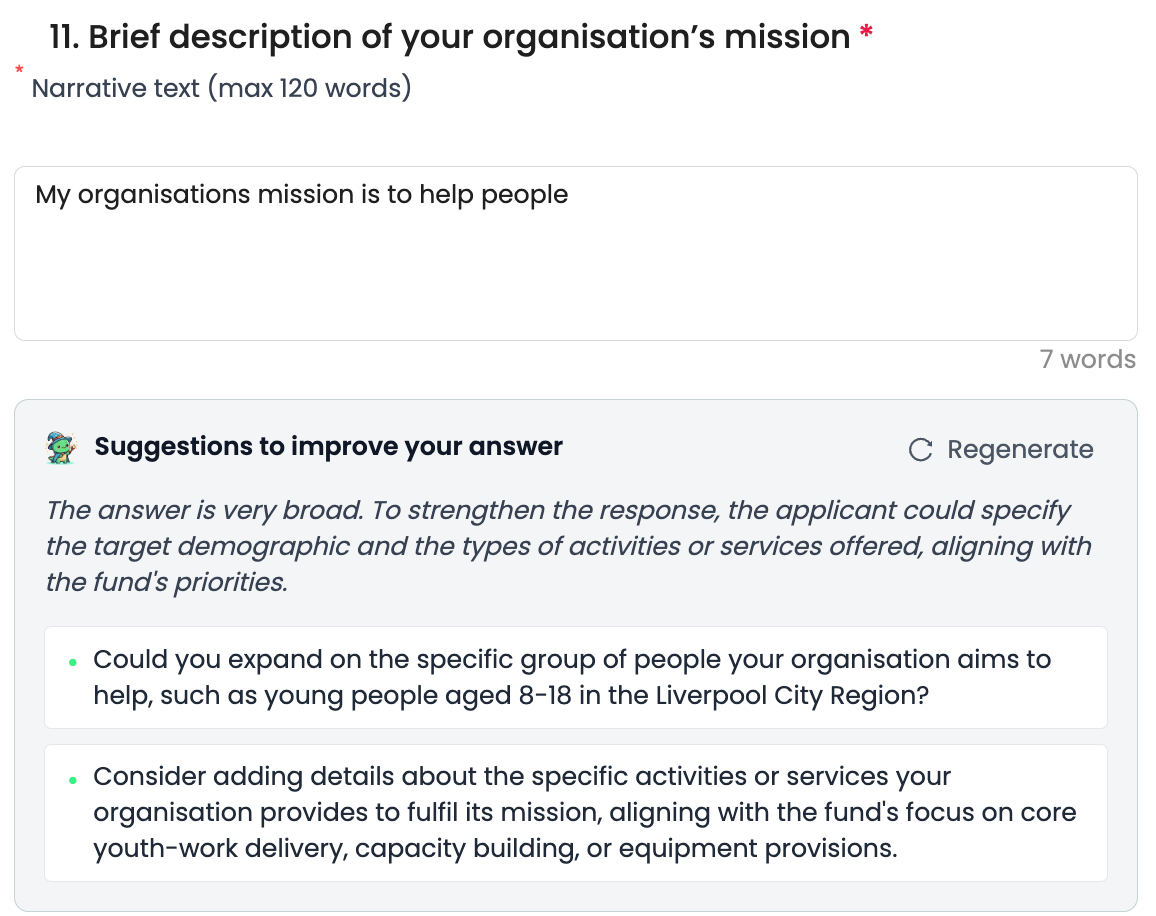
If they don’t have an application to feed into the system, we’ve also made built-in feedback so the organisation can get each question reviewed within the application and make sure they’re putting their best foot forward. Without feeding information about their organisation into a model that may not be protected.
And as a quick win: Plinth supports multilingual applications applicants can apply in their own language, with automatic translation back for funders. This matters particularly for community-facing funds where the people most in need of support are least likely to be writing fluently in formal English.
Of course all of these tools can be turned off by the funder. We used them in our most recent Plinth Foundation round and found it saved us time from questions asked and the quality of applications received improved as well
Better access, better decisions
There's a direct line between applicant accessibility and the quality of funder decision-making. When the process is easier, a wider and more representative range of organisations apply. Funders get a clearer picture of what's actually happening in their communities. Funding reaches the places it was always intended to reach.
The application form is not a neutral administrative step. It's the first thing a potential grantee encounters, and it sends a signal about whether a funder genuinely wants to hear from them.
Getting that experience right is part of what it means to be an equitable grant maker. We built Plinth to help funders do exactly that.