Does AI make better grantmakers?

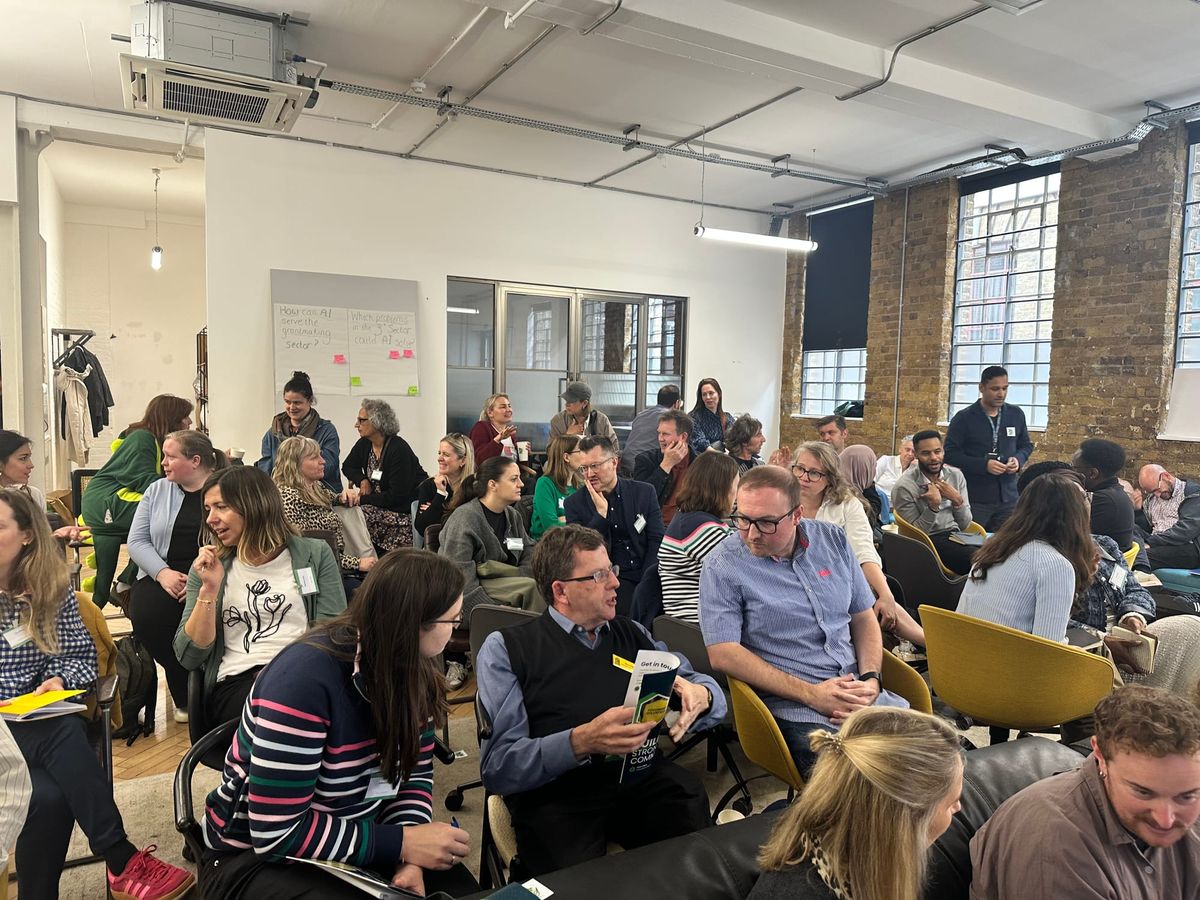
At our AI and grantmaking event, the concerns came up quickly and people were not afraid to voice them.
Their worries included the loss of the human touch, job displacement, small charities getting filtered out of the very process designed to support them, environmental cost, and unconscious and unpredictable bias embedded into the model before anyone's asked a single question.
None of these are trivial worries, and it's something we want to face head on in collaboration with voices in the sector. From there, the conversation turned to the more pressing question: how to make AI development subordinate to the concerns and needs of the sector, not the other way around.
Grantmakers want to fund as many organisations as possible. They want to move money quickly. They want to give bespoke feedback to applicants who weren't successful and help them try again. They want to stay relational. They want to support the small, emerging groups who are doing the most community-level work but have the least capacity to navigate the systems designed to fund them. These are the same things they've always wanted and what we’re working on to achieve.
Below are some thoughts that came out of the discussion.
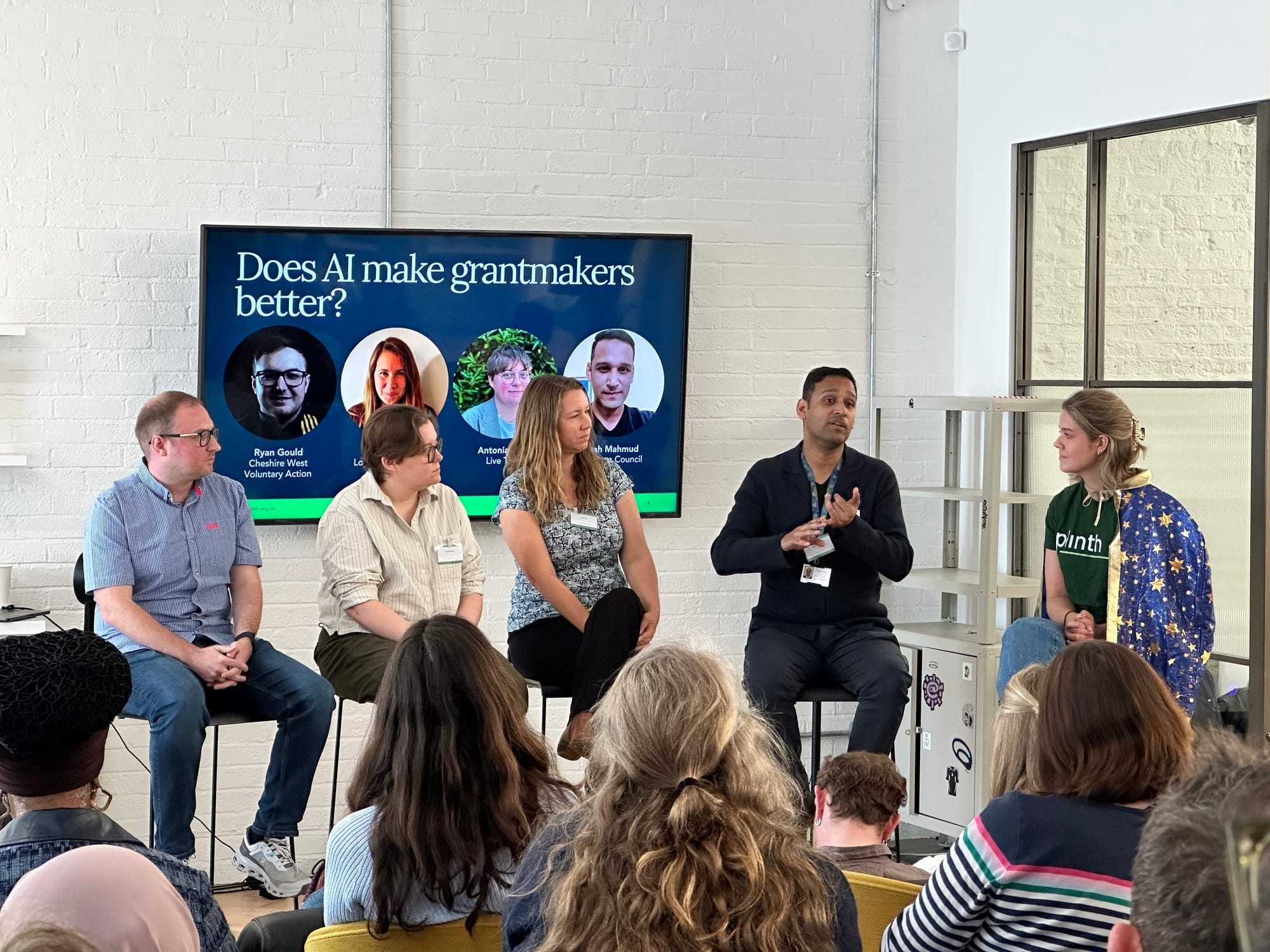
A panel on grantmaking from current users of Plinth. Pictured left to right: Ryan Gould (Cheshire West Voluntary Action), Antonia Lines (Live Trust), Sam Fox (London Community Foundation), Shah Mahmud (Newham Council) and Maria Toone (Plinth Partnerships Lead).
The PDF graveyard
One of the most striking things raised at the event was what grantmakers described as a "PDF graveyard": a huge accumulation of legacy data and documentation, sitting in shared drives and inboxes, completely disconnected from strategy, from decision-making, and from applications for further funding.
This is a story we hear a lot. Organisations doing genuinely important work have often been doing it for years, but the evidence of that impact is scattered. It lives in old reports, in spreadsheets no one has opened in years, and it never gets used.
This matters particularly for the organisations grantmakers most want to reach. The grassroots groups with the deepest community relationships are often the ones least able to articulate their own impact. Not because the impact isn't there. Because they're too busy doing the work to write it up.
AI, used carefully, changes that equation. Not by replacing the work of evidencing impact, but by making it more achievable. Surfacing what's already been collected. Turning raw data into something a grant assessor can actually use. Helping a small organisation apply for its next tender without needing a full-time fundraiser on the payroll.
The Bias in AI
Grantmakers are also rightly concerned about bias. AI systems inherit the assumptions of the data they're trained on, and those assumptions are not always visible or predictable. A system that learns to favour certain writing styles, certain organisational types, or certain geographies will quietly disadvantage some, without anyone intending it. There's a related concern that cuts deeper: grant assessors need to know what a good application looks like before they hand any part of the process to a tool. AI should be supporting experienced judgement, not substituting for it.
We’ve experienced this tension at Plinth already in development, Tom (our CEO) shared funny stories around our AI being strangely pro-cornish independence. Of course, this is a more trivial example of bias. But explicitly building AI to assist decision making, prompt thinking from the assessor rather than simply doing the assessing, is something we’ll continue to ensure.
The counterfactual
Humans need to be centred at every moment of decision-making, but not every part of the grantmaking flow is a "decision-making" stage. There's a real administrative burden that sits around those decisions, and ultimately hinders it. Whether it’s the document processing, the consistency checks, the feedback generation or the application summaries – there was a recognition that AI could free up time for the more important human-centric tasks.
The free time could go to somewhere useful, like more conversations with applicants and more capacity to support small organisations through the application process rather than just sending them a rejection letter. The insight that keeps emerging is simple: the more time saved by a streamlined process translates directly into impact. A large, well-resourced foundation with a grants team has administrative slack. A two-person community organisation does not. For them, an hour saved on an application is an hour back with the people they serve.
Remembering current process has flaws
Often when we discuss AI in grantmaking, what’s lost is appreciating how the current process itself is also not perfect.
Jargon-heavy applications. Portals that don't work on a phone. Twelve open-ended questions requiring several uninterrupted hours. The organisations that navigate these systems most fluently are, by and large, the ones that already have the infrastructure to do so. The ones with grants writers. The ones who've done it before. The organisations doing the most urgent work in the most under-resourced communities are the ones most likely to be filtered out before an assessor ever reads a word they've written.
If AI can reduce that friction consistently, if it can help a volunteer-run food bank submit an application that does justice to what they actually do, then the ethical case for using it carefully is strong. We just need to make sure it alleviates this without creating a different type of bias elsewhere.
What grantmakers said they want next
The first was a centralised data sharing platform, where multiple funders use the same system, with the ability to pool insights across a broader picture of community need. The potential here is significant. Right now, most funders are working from their own slice of information. A shared view would be genuinely transformative for understanding what's happening at a community level and directing funding accordingly. Optimistically, it’s a strength that our system definitely possesses.
The second was consistency with humanity. Grantmakers want AI to bring rigour and repeatability to the parts of the process that benefit from it, while preserving the relational quality that defines grantmaking at its best. They don't want a fully automated pipeline. They want to spend less time on paperwork and more time talking to the organisations they fund.
My three key-takeaways
- Funders are feeling the pressure of innovation and needing to do more with less, smaller headcounts, moving money faster, increased demand from funded organisations, working more efficiently and better evidencing impact to justify continued funding. Which is causing the surge in AI, and as Ryan Gould (Cheshire West Voluntary Action) said there is a real fear and ‘people are worried about being left-behind’ by not adopting AI.
- Relationships still matter. Grantmakers spoke in-depth about wanting to continue to be relational and this being an integral part of their funding experience. While AI can screen due-diligence, or provide an executive summary of a grant application, it can’t call a small charity to support them through the grant application process or cultivate those relationships that a human can.
- Fairness, integrity and transparency remain the core values at the heart of grantmaking, and in the wider third sector community who they fund. Grantmakers want these values to continue to be upheld throughout the technological advancements, and want these values key to the development and embedding of AI in their workplace.
Plinth is an AI-powered grant management platform built for the voluntary and community sector. If you want to talk about how we're approaching AI in grantmaking, email me at dominique@plinth.org.uk