For practitioners, seeing is preventing

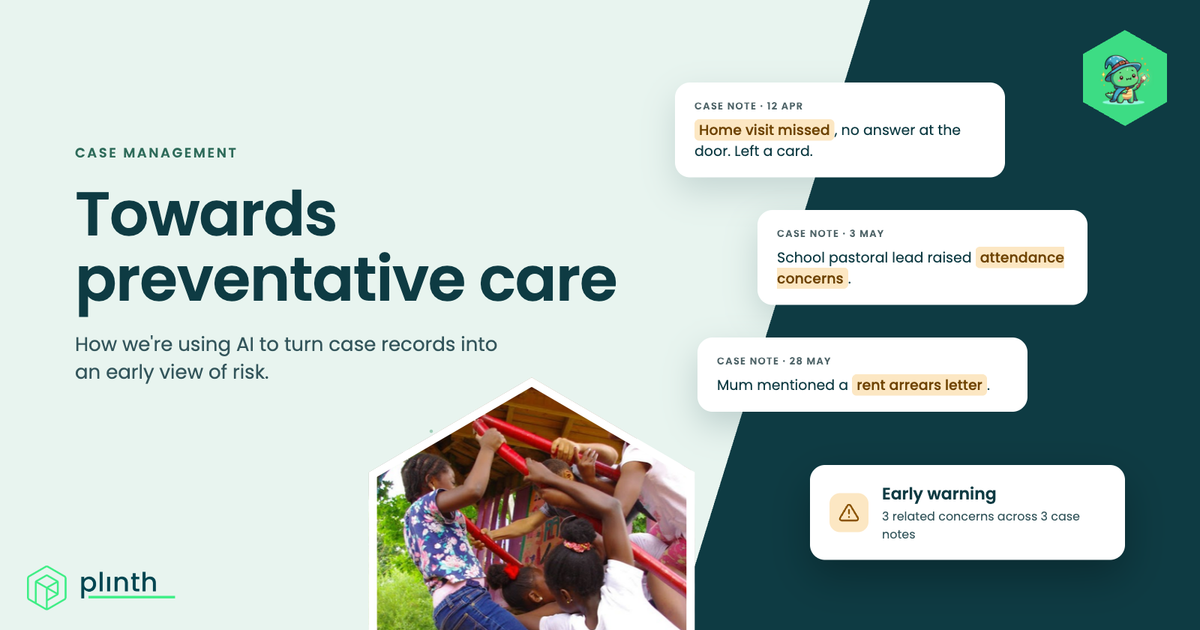
Over the last few months, I’ve delved into the unsexy world of case management. Beyond the stereotype of it being the bane of a practitioner's existence (largely due to terrible software) I think it’s perhaps the most important type of work that exists in the sector.
Currently, there is no other way local authorities and charities can assess vulnerable clients who use services, than standard case note workflows. Indeed, the human experience of speaking to a vulnerable individual and recognising their pain is foundational to social care. And it’s why we set out to design a system that truly aims to enhance this process.
Our main focus is developing a system which moves from reactive to preventative care. Not only does this follow recent NHS policy trends, but I think it gets to the heart of the most pressing structural issue which practitioners face.
A structural problem
Practitioners must become experts in anticipating risk. And when something serious does unfortunately end up happening, a standard process follows.
A review will be commissioned and a team will sit down with the file and work backwards through months of case notes, contact logs, referral forms and multi-agency minutes.
This is an incredibly inefficient process and has long been the default because technology has been the limiting factor. However, all the information that could be used to predict risk exists already, but our current systems are unable to surface patterns and trends in real time.
This has very real (and costly) consequences.
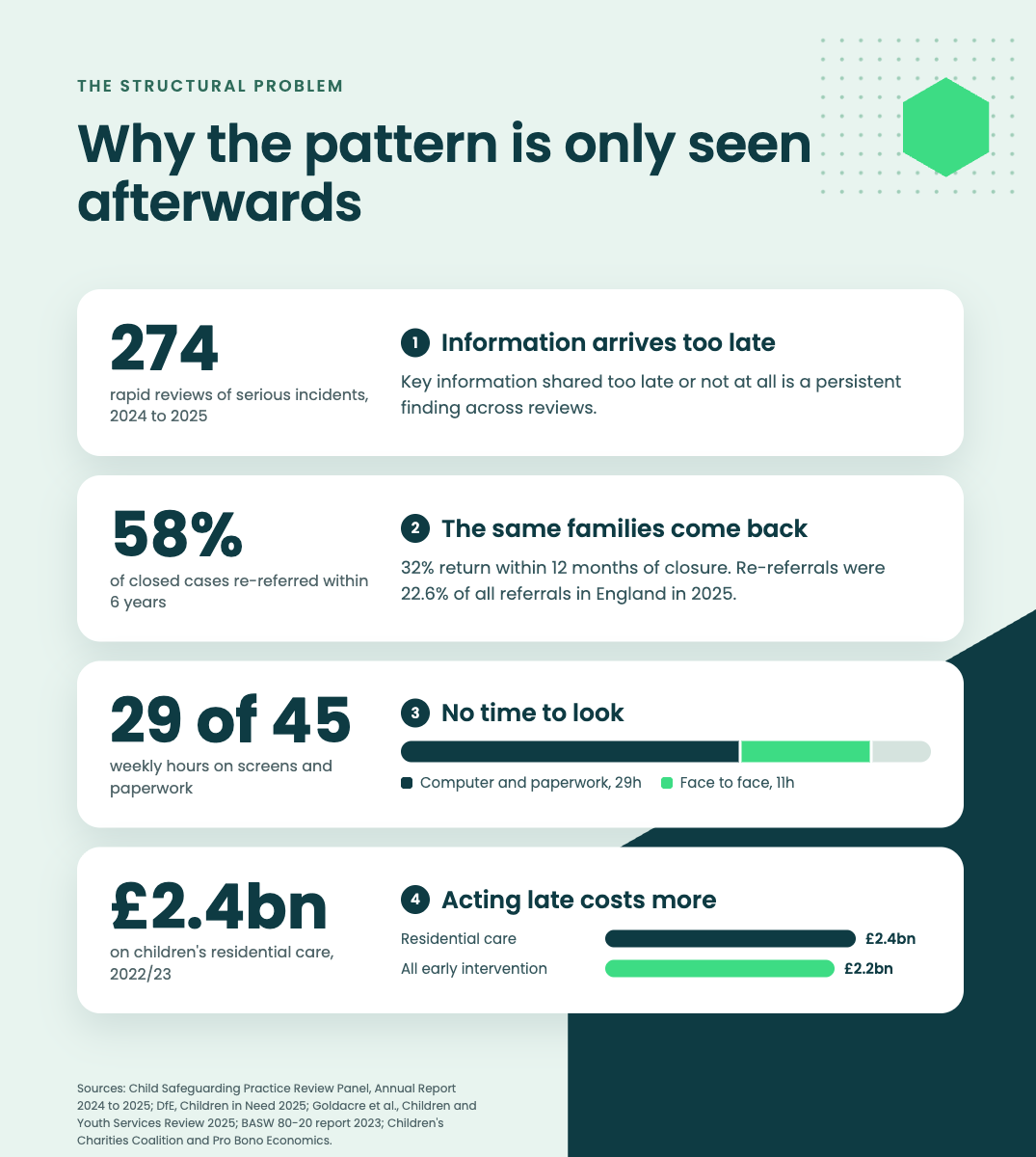
Information is routinely shared late: In 2024 to 2025 the Child Safeguarding Practice Review Panel considered 274 rapid reviews of serious incidents, affecting more than 360 children. Its persistent findings include key information shared too late or not at all, an over-focus on presenting issues rather than wider context, and learning from previous reviews not being embedded into practice [1].
The same families come back. Re-referrals made up 22.6% of all referrals to children’s social care in England in 2025, a similar level to previous years [2]. A study of 3.4 million closed cases found that 32% were re-referred within 12 months of closure, rising to 58% within six years [3].
The people best placed to spot patterns have the least time to look. BASW found social workers averaging a 45 hour week, with 29 hours spent on a computer or paperwork and 11 hours face to face with children and families [4].
Acting late is too costly. The Early Intervention Foundation estimates late intervention costs nearly £17 billion a year in England and Wales [5]. In 2022/23, councils in England spent more on children’s residential care placements (£2.4 billion) than on all early intervention services combined (£2.2 billion) for the first time [6].
Plinth’s preventative approach
Any sort of prevention is usually delivered through an early help team, a referral pathway or a programme. Each of these depends on someone noticing in time, so the case record itself has to help with the noticing. That asks three things of a case management system.
- It holds the whole person across episodes, including previous contacts, related family members and other services involved.
- It reads what practitioners write, so that a concern expressed in a case note is visible to the system and to managers.
- It shows the direction of travel, because the useful question is usually whether someone is getting better or worse, and how quickly.
How Plinth uses AI to do this
Understanding the problem has led us to approach case management system on three requirements. Two things should be achieved in this process: practitioners can regain time to spend on the most important part of their work and a holistic picture of the client can be built.
- Recording. AI case notes turn a home visit, Teams call or voice note into a drafted case note with follow-up actions, saved straight to the person's record. AI-assisted assessments and support plans cut the time spent writing up.
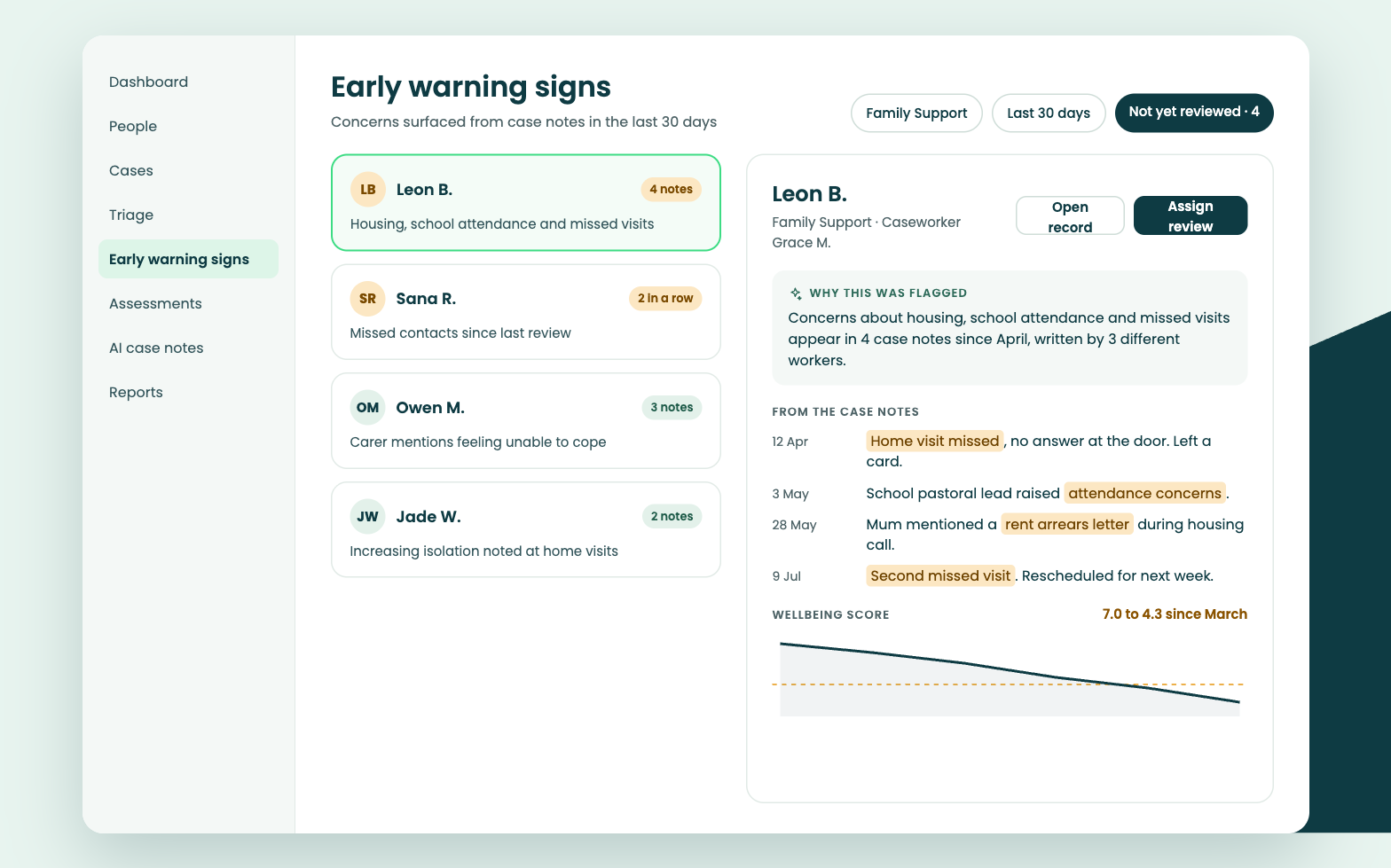
- Reading the record. Early Warning Signs reads recent case notes across the service and flags emerging concerns, so a change in tone or a repeated worry surfaces without anyone re-reading the file. Case note audits check the quality of recording.
- Trajectory. Assessments are scored against a baseline (or framework that practitioners set), so a worker or manager can see whether housing, finances, health or family life is improving or slipping between reviews.
- Flow and capacity. Triage suggests where each new referral should go based on pathway, concern and caseworker capacity. Pathway stages track how long people have waited, with alerts when a wait passes the threshold a team sets, and workload views show each caseload against capacity.
Crucially, software cannot predict harm. Any surfacing of potential harms or risks is dependent on what the practitioner’s framework outlines. A golden rule we always operate with is that the decision ultimately stays in the hands of humans who know best.
Future trajectory
We’re quite proud of what we've already built and current users are more than pleased. However, we constantly seek to make improvements which is informed by wisdom from the sector. And in the future we will do more updates on our developments.
So if you’re interested in seeing how it works live or want to get a demo, consider joining our Case Management Webinar on Wednesday 21 October, 11am to 12pm. Alternatively, email me at sean@plinth.org.uk.
Building stronger communities requires constant dialogue between tech providers and frontline workers, and that's what we always aim to do!
References:
[1] Goldacre et al., Predictors of re-referral to children’s social care, 2025
[2] Child Safeguarding Practice Review Panel, Annual Report 2024 to 2025
[3] BASW, 80-20 campaign report, Aug 2023
[4] DfE, Children in need 2025
[5] Children’s Charities Coalition, residential care spending tipping point